
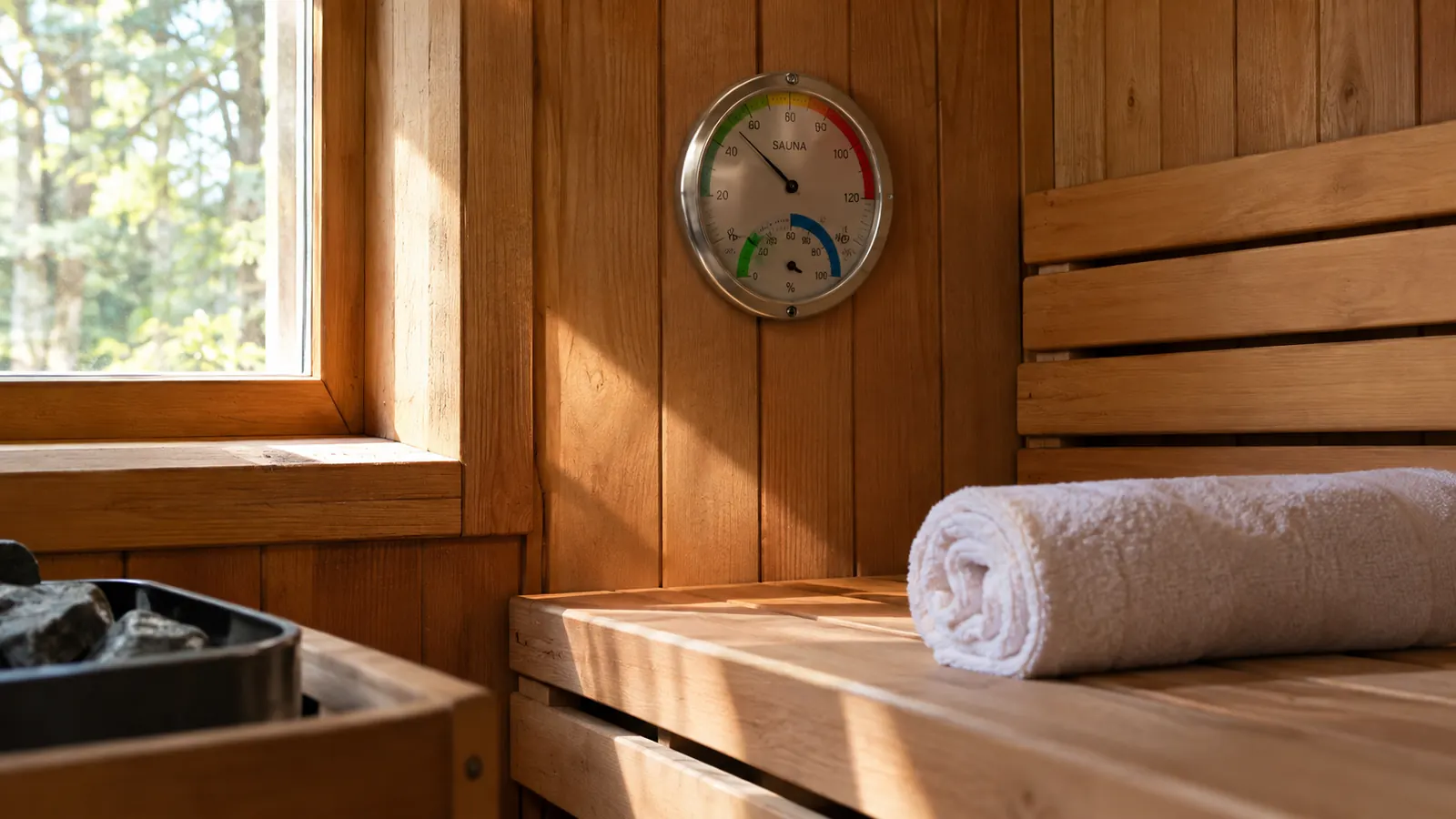
The first time I ran my new sauna, I spent most of the session with my hand hovering over the rocks, trying to guess whether it was hot enough to pour water on. I had a thermometer in the house, the kind you use for a turkey, but it wasn't going to survive 180 degrees. So I ordered the Defull stainless steel sauna thermometer and hygrometer, mounted it on the wall of the corner sauna we built in the basement, and then I did what I used to do with patients: I kept notes. Months later, this is what I can tell you.
It's a simple tool, and I think that's the point. One dial for temperature, one for humidity, both in a stainless housing that doesn't look out of place next to the cedar. If you're pricing your first sauna setup and wondering whether you actually need a thermometer on the wall, I'll give you my short answer up front, then the long answer.
The Quick Verdict
It does the one job a sauna thermometer should do: it tells you, at a glance, whether the room is ready and whether you're about to make it too steamy. Not fancy, not expensive, and after months of daily use, still accurate.
Amazon Check Today's Price →Know exactly when your sauna is ready, every single time
After months on the wall, the Defull thermometer hygrometer is still the first thing I check before I sit down. No guessing, no hovering over the rocks.
Amazon Check Today's Price on Amazon →How I've Used It
My husband Tom and I converted a corner of our finished basement into a small home sauna last fall. It's a kit build, cedar inside, with a wood stove that takes about forty-five minutes to get from a cold start to a good sitting temperature. That forty-five minutes is exactly why the thermometer earns its place. Without it, I'm opening the door every ten minutes, losing heat, and guessing. With it, I glance at the dial from across the room and know.
I use it almost every day, usually in the late afternoon after a walk on the treadmill. I've kept a little notebook on the shelf next to the door, and I jot down the temperature and humidity when I start, when I think the room is ready, and when I pour the first ladle of water on the rocks. After a few weeks, I noticed I was writing the same numbers over and over, which is exactly what I want from a tool like this. It's predictable.
The first week was the most instructive. I mounted the thermometer on a Tuesday in early November, the day after we finished the cedar paneling. That first session I kept checking it the way you check a new toy, and I learned something right away: the room heats unevenly. The air near the ceiling was reading 190 while the bench was still at 160. That's normal for any sauna, but I wouldn't have known it was normal without a dial telling me so. By the second week I'd stopped opening the door to check, and by the end of the month I had the routine down: start the stove around 4:15, close the door, and go about my afternoon until the needle crossed into the green. That's usually right around 5:00, and by 5:15 I'm sitting down with a glass of water and a book. The thermometer turned what used to be a guessing game into something closer to a schedule, and for a person who likes a routine, that's worth a lot. It also gave me something concrete to tell Tom when he asked how the new sauna was working: I could say the room hit 185 in forty-two minutes, instead of shrugging.
The humidity dial matters more than I expected. I learned early on that if I pour water on the rocks when the humidity is already high, the steam lingers and the room gets heavy. If I wait until the dial drops a bit, the air stays comfortable. That's not something I would have figured out without a gauge. I'm not a doctor and I don't give medical advice, but I will say this: check with your own doctor before you start heat therapy, especially if you have a heart condition, high blood pressure, or you're pregnant.

What the Dial Actually Tells You
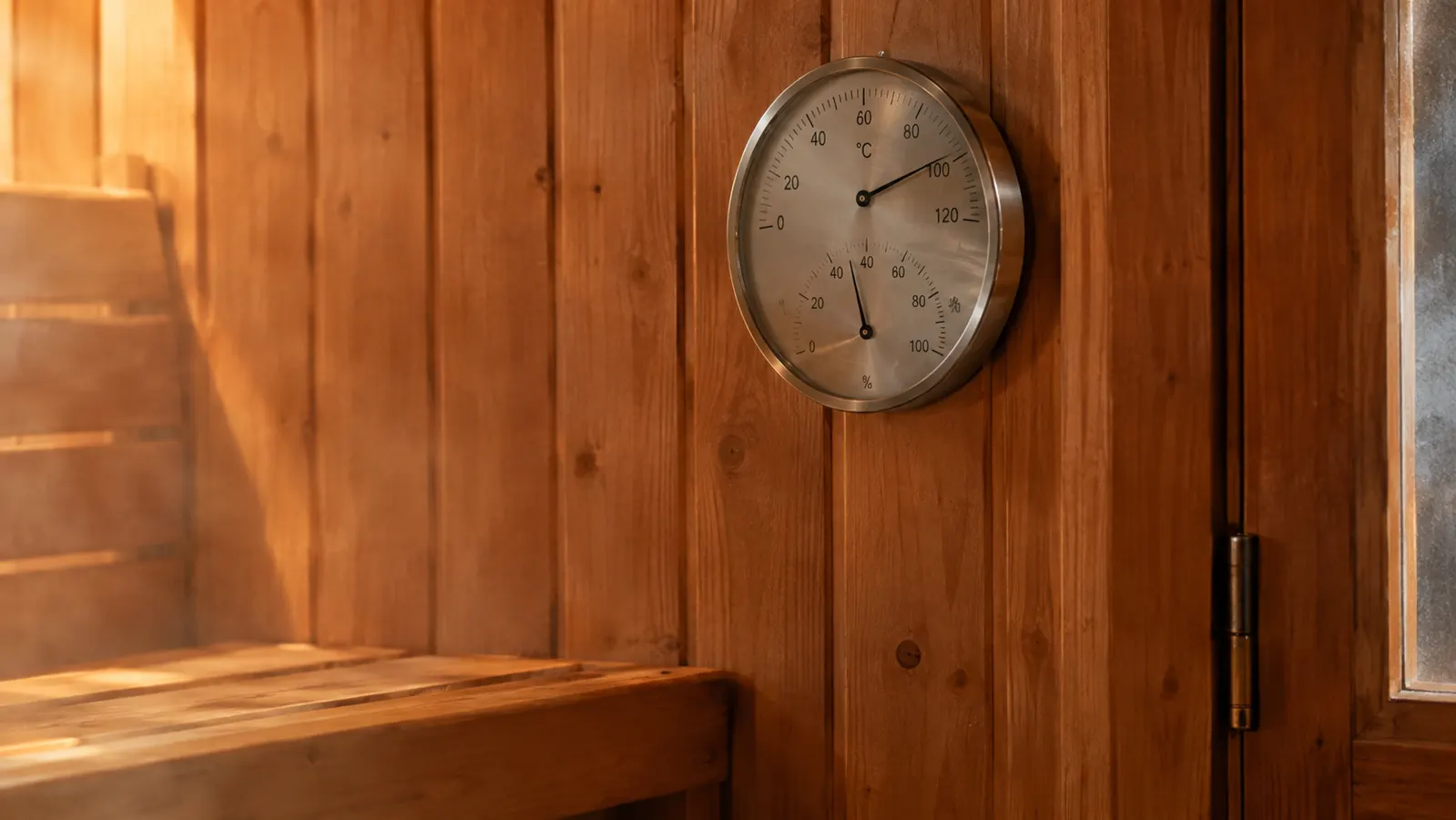
The Defull thermometer reads from 70 to 250 degrees Fahrenheit, which is the right range for a home sauna. The color-coded dial has a comfortable zone marked in green, which is handy when you're half asleep at six in the morning. The humidity side reads from 0 to 100 percent, and that's where I've spent most of my time looking.
I checked the accuracy the way I check most things: I borrowed a digital thermometer from my neighbor, the kind with a probe on a long wire, and ran them side by side for a week. During warmup, the Defull dial ran about three to five degrees behind the digital unit, which makes sense because the dial is mechanical and the digital probe is reading the air right next to it. Once the room settled at a steady temperature, the gap closed to about two degrees. For what I need, that's close enough.
The test ran for six days, from a Sunday to the following Friday, and I wrote down both readings every half hour during warmup. The biggest gap I saw was at the very start, when the digital probe read 78 and the Defull dial was still sitting at 70. The gap narrowed to about five degrees around 140, and by the time the room crossed 170 the two were within two degrees of each other. I also learned that the dial lags on the way down. After I opened the door to cool the room, the needle took its time catching up. That matters if you like to go in for a second round: you want to know when the room is actually cool enough to re-enter, not when the needle says it is.
The humidity reading is harder to verify, because humidity is more local than temperature. The air right next to the stove is different from the air by the bench. I hung the Defull on the wall opposite the stove, about chest height, and I treat its humidity number as a general guide rather than a laboratory measurement. That's the honest way to use any hygrometer in a sauna. On a dry January day, with the furnace running, the humidity dial might read 15 percent when I start. After I pour water on the rocks, it climbs to 40 or 45 within a few minutes, then drifts back down. I've learned to wait until it settles around 30 before I pour again. Those numbers are specific to my setup, my stove, and my basement, but they give you an idea of what the dial is actually doing. It's telling you a story about the air, not a precise scientific measurement, and once you accept that, it becomes a useful part of the routine.
Months of Daily Use: What Wears Well and What Doesn't
After months of nearly daily use, the stainless housing still looks the way it did the day I mounted it. No rust, no fogged lens, no peeling paint. The dial face is easy to read even when the room is full of steam, which surprised me. I expected condensation to blur the numbers, but the glass stays clear enough that I can read it from the bench.
I should also mention the screws. I mounted it with the two screws that came in the box, into the cedar paneling, and they have not loosened in all these months. That's not nothing. Our house settles, the wood expands and contracts with the heat, and a lesser mount would have gone crooked by now. I gave the face a wipe with a damp cloth once, back in January after a particularly steamy stretch, and that's the only maintenance it has needed. The one adjustment I made was in the second month: the temperature needle sat a couple of degrees low, so I turned the little screw on the back with a small flathead screwdriver until it matched my digital thermometer at room temperature. Took about thirty seconds, and it has held ever since.
The one thing that didn't survive is the little rubber plug on the back. It covers a hole that lets you adjust the dial with a small screwdriver, and after a few months of heat and cold cycles, the rubber got stiff and cracked. It still sits in the hole, but it's not doing much. It doesn't affect the reading, and I only mention it because I want you to know what a year of use actually looks like. Nothing is perfect.
After months of daily use, the Defull still reads within two degrees of my digital thermometer once the room settles. That's the whole job, done well.
Where It Shines and Where It's Just Fine
The best thing about this thermometer is that it's boring in the right way. It doesn't beep, it doesn't need batteries, it doesn't need a Wi-Fi connection. I mounted it with two screws and it has sat there ever since, doing its job without asking for attention. For a person who spent twenty-five years in physical therapy, there's a lot to be said for equipment that doesn't demand anything from you.
The color-coded zones are genuinely useful. When the needle is in the green, I know the room is in a good range for sitting. When it's in the red, I know I've let it run too long or poured too much water. That's the kind of feedback that keeps a beginner from making the same mistake twice. The red zone taught me my limit. One evening in December I got distracted reading and let the stove run past the usual time. When I finally looked up, the needle was deep in the red, past 200, and the room had that dry, scorched feel that's no fun to sit in. I opened the door, let it cool back into the green, and started over. Without the color coding, I might have convinced myself it was fine and sat down anyway. Instead, one glance at the dial saved me an uncomfortable session. That's the kind of feedback I used to give patients about their posture: you don't need to feel the problem to know it's there, you just need someone to point it out.
Where it's just fine: the humidity dial is not a precision instrument. If you're the kind of person who wants to know the exact relative humidity to the decimal point, this isn't that. It's a guide, and it's a good guide, but it's not a lab tool. Also, the mounting holes are on the top and bottom, which means you have to be careful about where you place it on the wall. I put mine at an angle the first time, and the dial was tilted enough that I had to redo it.
The mounting story has a happy ending, but it taught me to use a level. The holes sit at the top and bottom of the case rather than side to side, so if you get one screw a little high, the whole face tilts. My first attempt was off by maybe ten degrees, just enough to make the needle look like it was pointing somewhere it wasn't. I took it down, marked the holes with a pencil, and remounted it in about ten minutes. If you're handy with a level, you'll get it right the first time. If you're like me and skip that step, you'll learn the same lesson I did.
What I Liked
- Large, color-coded dial that's easy to read across a steamy room
- Stainless housing that has held up through months of daily heat and moisture
- No batteries, no calibration routine, no app, nothing to fail
- Temperature reading stays within a couple of degrees of a digital reference
- Humidity dial is a practical guide for timing water on the rocks
- Simple two-screw mount that takes about five minutes to install
Where It Falls Short
- Rubber plug on the back cracked after a few months of heat cycles
- Humidity reading is a general guide, not a precision measurement
- Mechanical dial lags a few degrees behind digital during warmup
- Mounting holes on top and bottom make it easy to install slightly crooked
Who This Is For
This thermometer is for the person who is building their first home sauna and wants to know, without guessing, when the room is ready. It's for the person who likes to sit in the heat and let their mind go quiet, not the person who wants to monitor a data dashboard on their phone. It's for the person who, like me, would rather spend a few dollars on a simple tool that works for years than spend a lot of dollars on a smart device that needs updates.
If you're using an infrared blanket or a steam tent, you may not need a wall thermometer at all. Those units have their own controls and their own readouts. But if you have a barrel sauna or a cabin sauna with a wood stove or an electric heater, this is the piece that tells you when to stop waiting and start sitting. It's also a nice safety check: you know at a glance if the room is too hot to be sensible.
Who Should Skip It
Skip it if you want exact humidity numbers, because this dial gives you a range, not a precise reading. Skip it if you want a thermometer that connects to your phone, because this one doesn't connect to anything. And skip it if you already have a reliable way to know your sauna temperature, because this won't do anything magical. It's a tool, not a toy, and it's honest about that.
I'd also say: if you're shopping for a sauna and you haven't bought the sauna yet, don't buy the thermometer first. Buy the sauna, use it a few times, and see whether you're actually guessing at the temperature. I suspect you will be, and that's when this becomes worth its small price. But it's an accessory, not a necessity, and I like knowing the difference.
The simplest upgrade to your sauna routine
A glance at the wall instead of a guess at the rocks. The Defull thermometer hygrometer has earned its spot in my daily routine, and it's still going strong.
Amazon Check Today's Price on Amazon →