

I bought this thermometer the same week we finished the sauna in the corner of our basement, mostly because I do not like guessing at heat. After 25 years as a physical therapy assistant, I have seen what happens when people guess: they either sit too long and feel awful, or they give up because it does not feel like anything is happening. My knees and lower back need the first kind of session to loosen up, not the second kind that ends in frustration. So I ordered the Defull stainless sauna thermometer hygrometer, mounted it at eye level next to the bench, and spent the next six months learning what it does well and what it simply does not do.
Here is the honest part, the part the product page does not spell out. A thermometer like this is a guide, not a guarantee. The number on the dial depends on where you hang it, how long the sauna has been heating, and whether you trust the humidity reading at all. None of that makes the gauge useless. It makes it a tool you have to understand before it can help you. This review is about what I learned using it every other day through a long Minnesota winter, and what I would tell a friend who is trying to decide whether this is the thermometer for their own sauna. If you are the kind of person who wants a number to tell you exactly what to do, you may find this review frustrating, because my honest answer is that the gauge helps, and then you still have to use your own judgment. And the standard disclaimer I give everyone: check with your own doctor before starting any heat therapy, especially if you have a heart condition, blood pressure concerns, or you are pregnant.
The Quick Verdict
A large, readable dial and a stainless case that has held up to months of steam, as long as you mount it where you actually sit and treat the humidity number as a rough guide.
Amazon Check Today's Price →Read the temperature from the bench, not the doorway
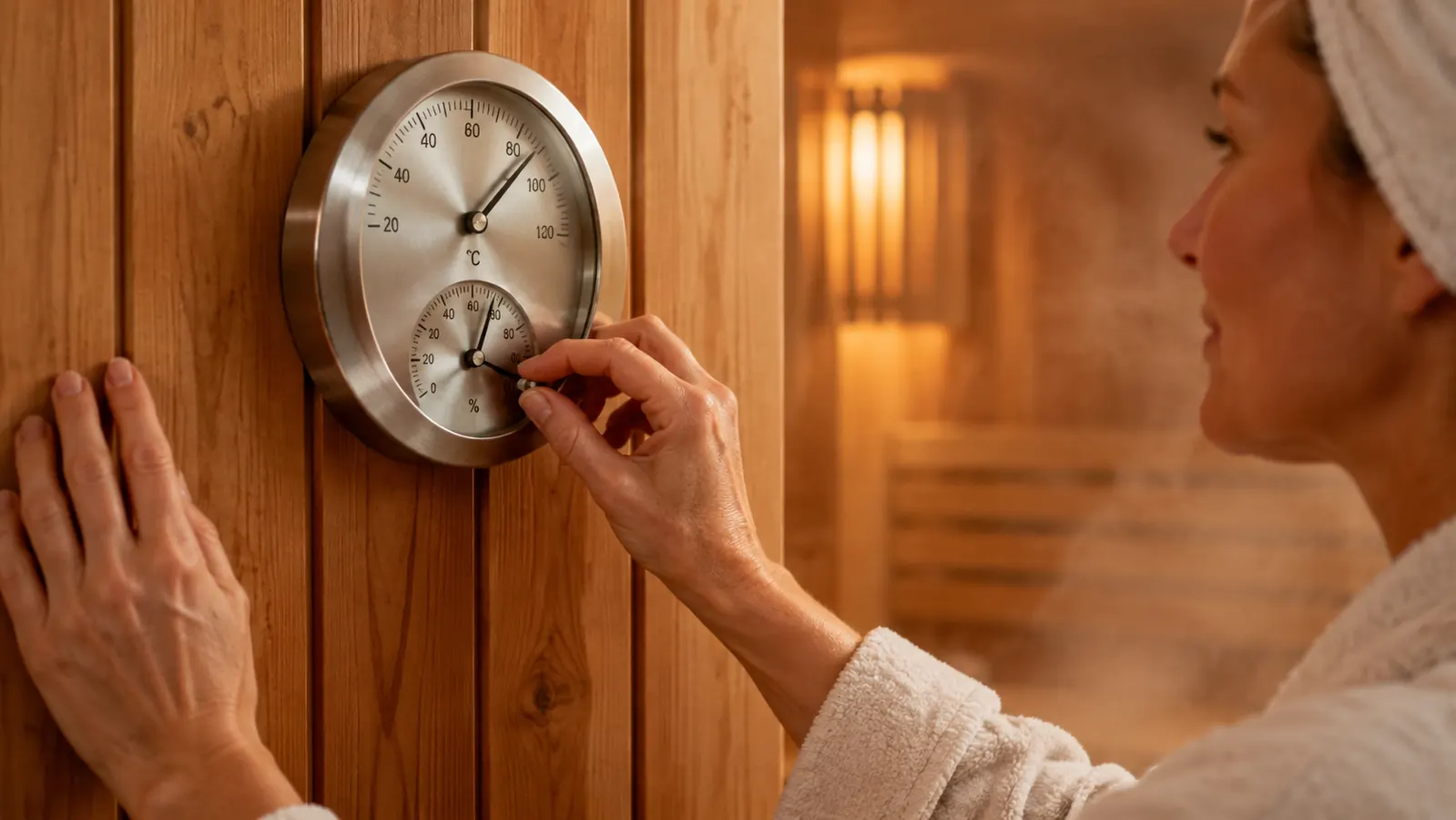
The Defull sauna thermometer hygrometer has a big color-coded dial you can read while you are sitting down, which is more than I can say for the first gauge I tried. If that sounds like what your sauna is missing, it is worth a closer look.
Amazon Check Today's Price on Amazon →How I've Used It
The sauna sits in a converted corner of our finished basement, next to the treadmill I walk on most mornings. On a typical evening I do a slow twenty minutes on the treadmill, let myself cool down for a few minutes, and then head into the sauna for a fifteen to twenty minute session. The thermometer is mounted on the wall at bench height, roughly level with my eyes when I am sitting. That placement matters more than any other decision I made, because heat rises. A gauge hung near the ceiling will read twenty degrees hotter than one hung at the bench, and the number you actually need is the one where your body is. And before anyone asks, I did not hang it above the heater. It looks tidy in photos, but the number up there tells you about the air near the ceiling, not the air around your shoulders.
The dial covers 70 to 250 degrees Fahrenheit, and the humidity scale runs from zero to one hundred percent. I check it twice during a session: once when I first sit down, and again around the ten minute mark. After that I mostly ignore it and go by how I feel, which is the same advice I gave patients for years about exercise. The gauge tells you the conditions. Your body tells you how to respond.
I also use the thermometer when I am heating the sauna from a cold start, because it gives me a reason to slow down. It takes a while for the air to come up to temperature, and the dial gives me something concrete to watch instead of opening the door every few minutes and letting the heat out. That may sound like a small thing, but for someone who is used to hurrying through everything, it has become part of the ritual. Tom uses the sauna a couple of times a week as well, and he reads the dial from the bench without a single complaint, which I consider a strong endorsement from a man who will not wear reading glasses.
The first time we used the sauna, the mounting shifted slightly when I leaned against the bench, and the gauge ended up angled toward the corner. It still worked fine, but it was harder to read from my seat. A small adjustment fixed it, and now I check the angle every few weeks. I also learned that a dial like this is easiest to read when it sits square on the wall, and it takes ten seconds to check with a level before you tighten the screws. I did not bother at first, and the needle was still accurate, but the whole thing looked crooked and it bothered me every time I walked past. Straighten it while you are up on the stool and you will never think about it again.
What Nobody Tells You About the Humidity Number
The hygrometer half of this unit is the part I have the most mixed feelings about, and it deserves a straight answer. The humidity reading is slow. In a hot, dry sauna the needle moves gradually, and when you pour water on the stones, the reading takes a long time to catch up to what your skin already knows. It is a mechanical sensor, not a digital one, and it behaves like it. If you are expecting the instant response of a digital weather station, you will be disappointed. That is not a criticism as much as a warning, because a lot of people expect weather-station behavior from a mechanical gauge.
The other thing nobody mentions is that the humidity number is only meaningful where the gauge hangs. The air near the ceiling is hotter and drier than the air at the bench, so the same sauna can show a different percentage depending on where you mount the unit. I have learned to use the hygrometer for one thing only: to know when the sauna has settled after I pour water on the stones. When the needle stops moving, the air has stabilized and I can relax into the session. As a precision instrument it would frustrate me. As a rough guide it is fine.
The color-coded comfort zone on the dial is where I would push back a little. The markings make it look like there is one ideal spot on the scale, but comfort in a sauna depends on your experience, how long you have been inside, and what you did that day. A beginner will not find the same zone comfortable as someone who has used saunas for years. I treat the colored band as a suggestion, not a target, and I would tell anyone new to saunas to do the same.
Accuracy: Close Enough, Once You Understand It
I checked the dial against the thermometer built into our sauna heater, which is not a laboratory instrument either, but it gave me a rough sense of how honest the gauge is. At bench height, with the sauna fully heated and the door closed, the Defull thermometer stayed within a few degrees of the heater's reading. That is close enough for a fifteen minute session. The difference between 165 and 170 degrees is not something my knees can feel, and I would not want to make a decision based on a single degree anyway.
I also moved the thermometer around during the first week to see how much the reading changed with height. At the bench it read true to what I felt. At the ceiling it read noticeably higher, and down near the floor it read lower. None of that is a defect. It is simply the physics of hot air, and it is the reason I keep telling people to mount the gauge where they sit. If you only ever look at a thermometer hung high on the wall, you will be chasing a number that has nothing to do with your body.
What I did notice is that the dial lags when the temperature is changing. If I open the door to grab a towel, the needle takes its time dropping, and it takes even longer to climb back up once the door is shut. That is normal for an analog gauge with a metal coil inside, and it is worth knowing before you buy. If you want a thermometer that updates every second, this is not it.
There is also no way to calibrate it, at least not that I have found. I did not want to pry the case open to find out whether an adjustment screw exists, so I will not pretend to know. My advice is to check it against a known reference when it arrives, note the difference, and then just be consistent. A thermometer that is always a few degrees off in the same direction is still a useful thermometer, because you learn to read it the way you learn to read any tool.
Readability From the Bench: The Best Part
Here is where this thermometer earns its keep. The dial is five inches across, which sounds small until you are sitting a few feet away with steam in the air at the end of a long day. The numbers are large, the markings are clear, and the color-coded zones make it easy to see at a glance where the needle is pointing. I can read it without my glasses, and that is the highest compliment I can give a gauge in a sauna. My eyes are not what they were at forty, and this is one of the few things in our basement I never have to lean in to read.
The one honest complaint I have is the light. There is no backlight on this dial, so if your sauna is dimly lit, you will be squinting. Our sauna has a small light above the bench, so I have not had to solve this, but I would not want to rely on this thermometer in a room lit only by a candle. If you are building a sauna in a dark corner, budget for a light near the gauge.
I also appreciate that the whole face is easy to wipe down. After a steamy session the glass collects a little condensation, and a quick pass with a towel clears it. I have not seen any fogging inside the case, and the markings have not faded in six months of use. That matters more than it sounds like, because a thermometer you have to baby is a thermometer you will stop using.

Six Months In: What Wears, What Doesn't
The stainless case has held up well. Six months of heat, steam, and the occasional splash of water have not left any rust or corrosion that I can see, which was the main thing I worried about when I hung it on the wall. The mounting has stayed tight, and the needle still returns to the same spot when the sauna cools down, which tells me the mechanism is still doing its job.
The winter test was the one I cared about most. Our basement stays cool in January, so the sauna starts from a colder place and takes longer to heat. The dial sat at the bottom of its range those first few minutes, then climbed steadily as the room warmed. It was reassuring to watch, and it confirmed that the gauge responds to the air around it rather than to the heat of the wall behind it. I had wondered whether the mounting plate would transfer heat and throw the reading off, and in our setup it does not seem to.
The honest caveat is that six months is not a lifetime. The real test for anything in a sauna is a few years of regular use, and I cannot tell you how this gauge will look after that. What I can tell you is that nothing about it so far suggests it is wearing out. It is a simple tool at a reasonable price, and I would rather replace a simple thermometer every few years than pay a lot more for features I would not use.
What I Liked
- Large five inch color-coded dial that is easy to read from the bench without glasses
- Stainless case has held up to six months of heat and steam without rust or corrosion
- Simple analog design with nothing to charge, update, or troubleshoot
- Shows both temperature and humidity in a single wall mounted unit
- Reasonable price for a tool that does one job and does it clearly
Where It Falls Short
- Analog gauge drifts and lags, so do not expect laboratory accuracy
- Humidity reading is slow and only meaningful where the gauge hangs
- No backlight, which makes it hard to read in a dim sauna
- The color-coded comfort zone is optimistic for beginners
- No way to calibrate it that I have found
Checked against the heater's thermometer at the same height, the dial stays within a few degrees, and that is close enough for a fifteen minute session.
Who This Is For
This thermometer is for someone who wants a simple, readable gauge and does not need their sauna to send data to a phone. It is for the person who wants to know, roughly, how warm the room is, and who understands that the number is a starting point rather than the whole story. It is also for anyone who likes analog tools that do not need charging, updating, or troubleshooting.
If that sounds like you, the Defull sauna thermometer hygrometer is a sensible pick. It does what it claims to do, it has held up well in our basement sauna, and it has not made me wish I had bought something fancier. In my experience, that last part is the real test of any piece of wellness gear.
Who Should Skip It
Skip it if you want precise digital readings with a backlit screen, or if you plan to use the hygrometer to track humidity seriously over time. Skip it if you want a thermometer you can calibrate, or one that updates instantly when the door opens. And if your sauna is lit only by a tiny window, the lack of a backlight will bother you more than it bothered me.
None of those are failures of this product. They are simply cases where a different tool would serve you better. A digital thermometer with a remote sensor might be worth the extra money for you, and I would not argue with that choice. For my own routine, the Defull gauge is the right amount of technology: enough to be useful, not so much that it gets in the way.
One last thing. If you are choosing between this and a wooden gauge because you like the way wood looks in a sauna, that is a style decision, not a performance decision. Both will tell you roughly how warm the room is. Pick the one you will enjoy looking at for the next few years, because a gauge you like will get used.
The verdict, plainly
The Defull sauna thermometer hygrometer is not a precision instrument, and it does not pretend to be once you understand it. It is a clear, honest gauge that has sat in our sauna for six months without complaint. For most home sauna owners, that is exactly enough.
Amazon Check Today's Price on Amazon →